State and Society up to 1000 CE Class 9 Question and Answer
NCERT Questions and Answer
1..How did political organization change from the Vedic period to the age of large empires such as the Mauryas and the Guptas? Explain the administrative system of the early Indian.
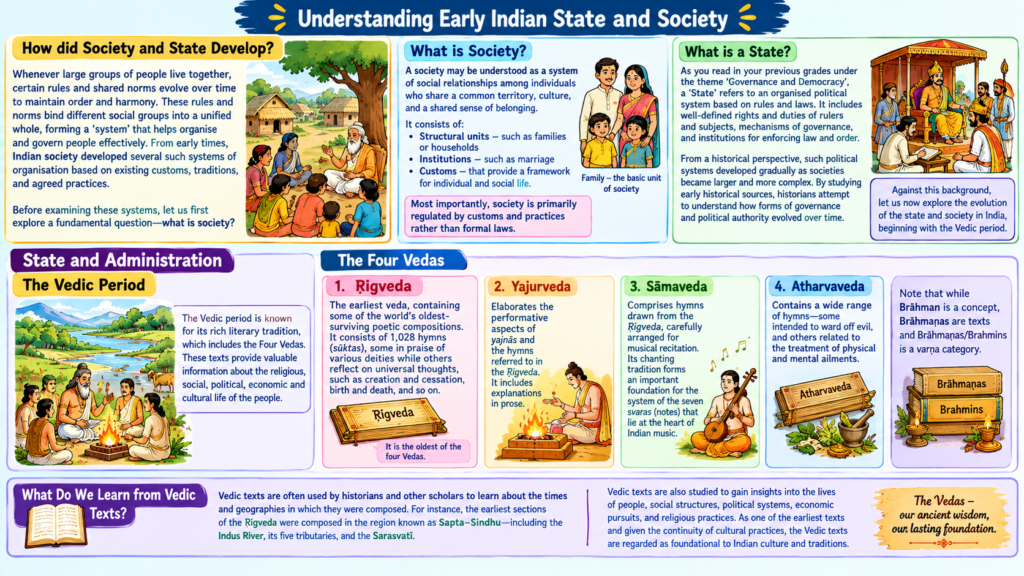
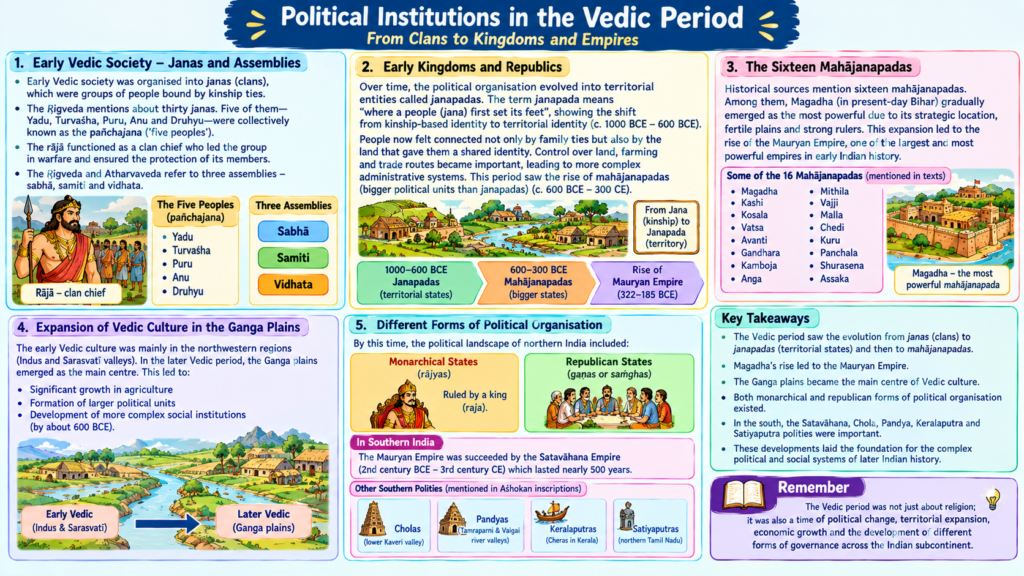
Ans – In the Vedic period, political organisation was mainly based on tribes and small kingdoms. The king (raja) was assisted by assemblies such as the Sabha and Samiti.
By the time of the Mauryas and Guptas, political organisation had become much larger and more centralised. Powerful kings ruled large empires with organised armies, officials, taxation and administrative divisions.
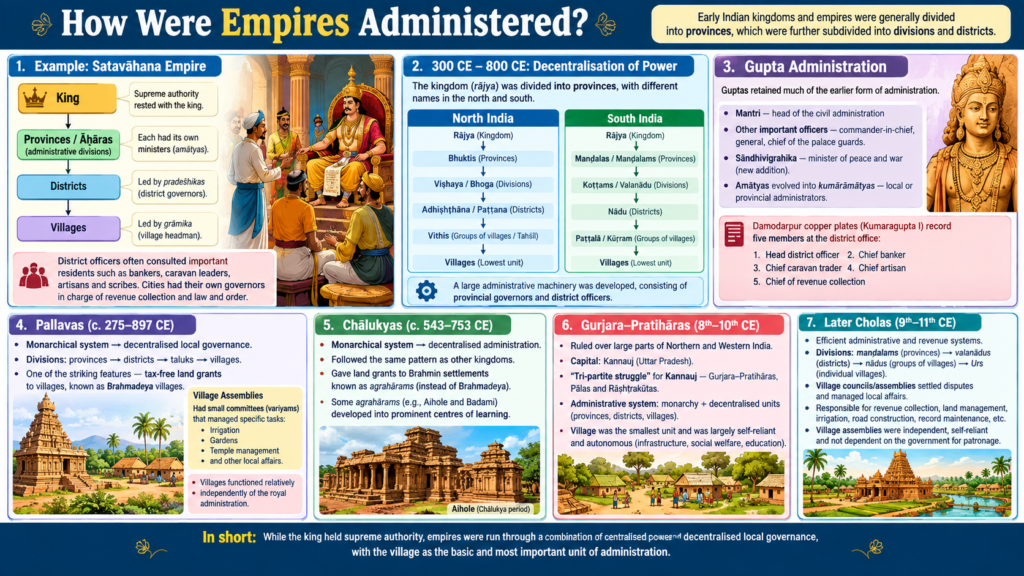
Administrative system of early Indian states:
The king was the central authority.
Officials and ministers helped in administration.
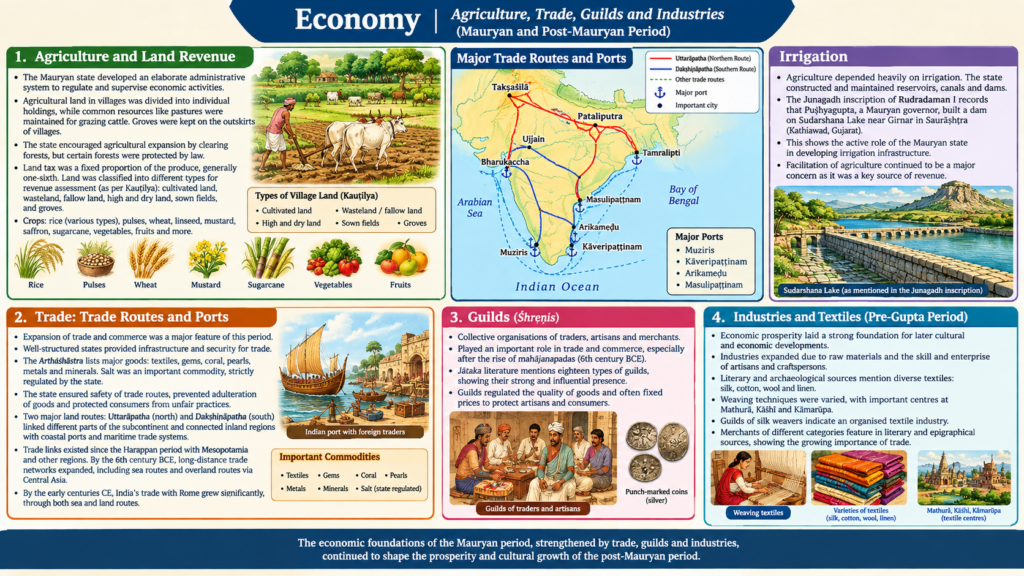
The state collected taxes from agriculture, trade and other activities.
Large kingdoms were divided into smaller administrative units for easier governance.
The Mauryas maintained a strong central administration and large army, while the Guptas used both central officials and local rulers/administrators.
Thus, Indian political organisation gradually changed from small tribal chiefdoms to large, organised and bureaucratic empires.
2. Describe the role of the king important officers and the methods used to govern large Territories.
Ans – In early Indian states such as the Mauryan and Gupta empires:
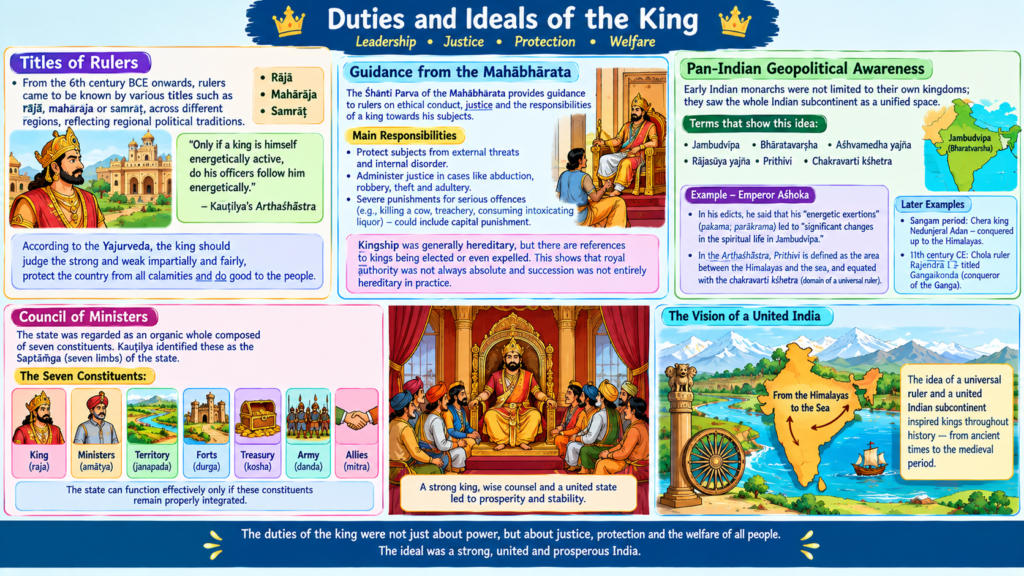
King: The king was the supreme authority. He maintained law and order, protected the kingdom, collected taxes, and led the administration and army.
Important officers: Ministers, military commanders, tax collectors, judges, governors and other officials helped the king run the state.
Thus, a strong central government supported by officials and local administration helped rulers govern large territories.
3. After studying this chapter, what do you think were the most important features of the state and society in India before 1000 CE?
Ans – The most important features of the state and society in India before 1000 CE were:
Kings and kingdoms played an important role in administration and defence.
Villages and local communities were important units of society and economy.
Agriculture, trade and crafts were the main economic activities.
Society was diverse, with different communities, occupations, languages and traditions.
Religions, education, art and literature developed and flourished during this period.
4. What do early texts such as the Rigveda, Arthashastra and Mahabharata reveal about political and social life?
Ans – Early texts like the Rigveda, Arthashastra and Mahabharata provide information about the political and social life of ancient India.
Rigveda: Describes kings, assemblies, tribes and the role of warriors and priests.
Arthashastra: Explains the administration of the state, taxation, army, officials and duties of the king.
Mahabharata: Gives insights into kingship, warfare, family relationships, social duties and values.
5. What can we learn from early Indian society about Varna and the role of women?
Ans – Early Indian society shows that Varna divided society into different social groups based mainly on occupation and duties. Over time, these divisions became more rigid.
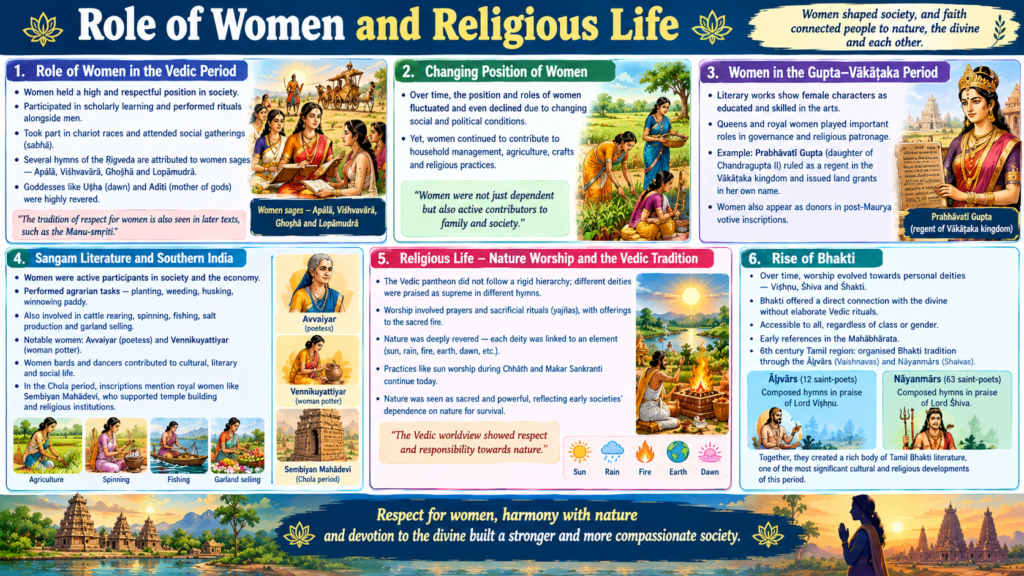
Women played important roles in family, religious activities, education and society, though their position varied in different periods and communities. Some women had access to learning and participated in public life.
6. Explain how assemblies like Sabha and Samiti limited the power of the raja. Which modern institutions perform similar functions today?
Ans – The Sabha and Samiti were important assemblies in the Vedic period. They discussed important matters and advised the raja, which helped limit his power and prevented him from ruling completely on his own.
In modern India, similar functions are performed by the Parliament (Lok Sabha and Rajya Sabha) and State Legislative Assemblies, which discuss laws and keep a check on the government.
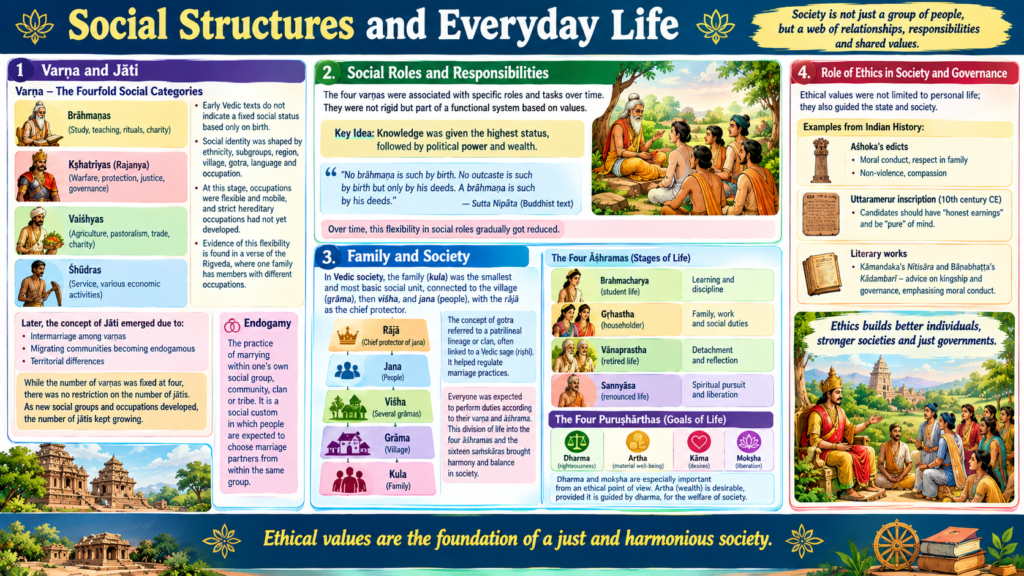
7. What do the terms varna and jati refer to in early Indian society? How were they different and what factors may have contributed to the formation of various jatis?
Ans – Varna refers to the four broad social categories mentioned in early Indian texts—Brahmana, Kshatriya, Vaishya and Shudra—based mainly on duties and occupations.
Jati refers to the many smaller social groups into which people were organised, often connected with occupation, region, community and social practices.
Difference: Varna was a broad four-fold classification, while jatis were numerous and more specific groups.
Various jatis developed due to different occupations, local customs, communities, migration and the growth of new groups and professions.
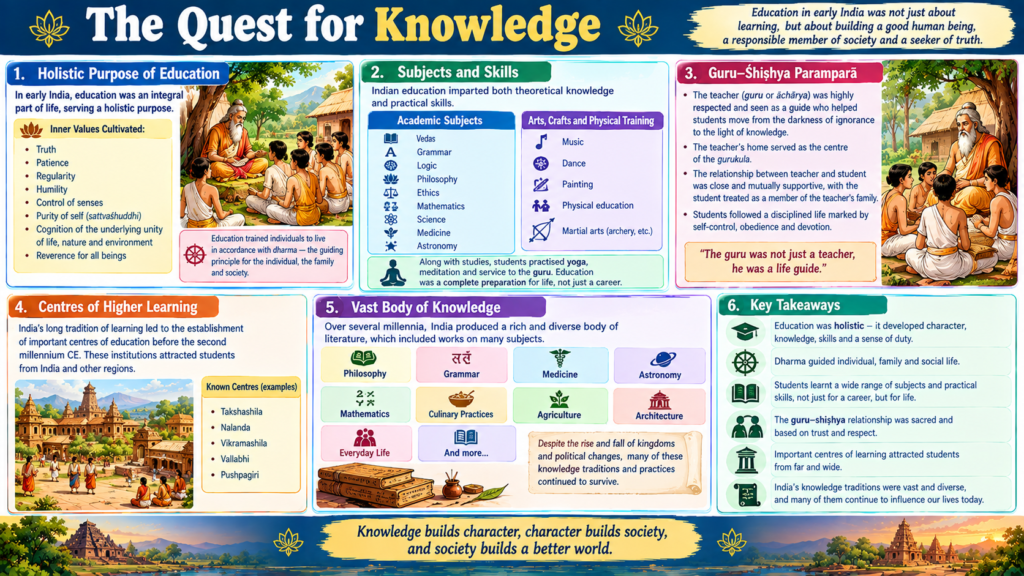
8. Why do we think education in ancient India emphasized both knowledge and moral values? How might this have benefited society?
Ans – Ancient Indian education emphasized both knowledge and moral values because education aimed not only to make a person knowledgeable but also to develop good character, discipline, responsibility and respect for others.
This benefited society by creating responsible citizens, promoting harmony and encouraging people to perform their duties honestly.
9. Look at the major trade routes of early India. How do you think these routes helped people in the exchange of goods, skills, beliefs, and cultural practices?
Ans – The major trade routes of early India helped in the exchange of goods, ideas and culture. Traders carried products such as spices, textiles, metals and precious stones to different regions. Along with goods, people also shared skills, technologies, languages, beliefs, art and customs.
10. What might have been the advantages and challenges of ruling a large empire in the absence of modern communication systems?
Ans – Ruling a large empire without modern communication systems had both advantages and challenges.
Advantages: The ruler could control a vast territory, collect taxes, protect trade routes and spread laws and culture.
Challenges: Messages travelled slowly, making it difficult to respond quickly to rebellions or local problems. Maintaining roads, armies and officials was also costly.
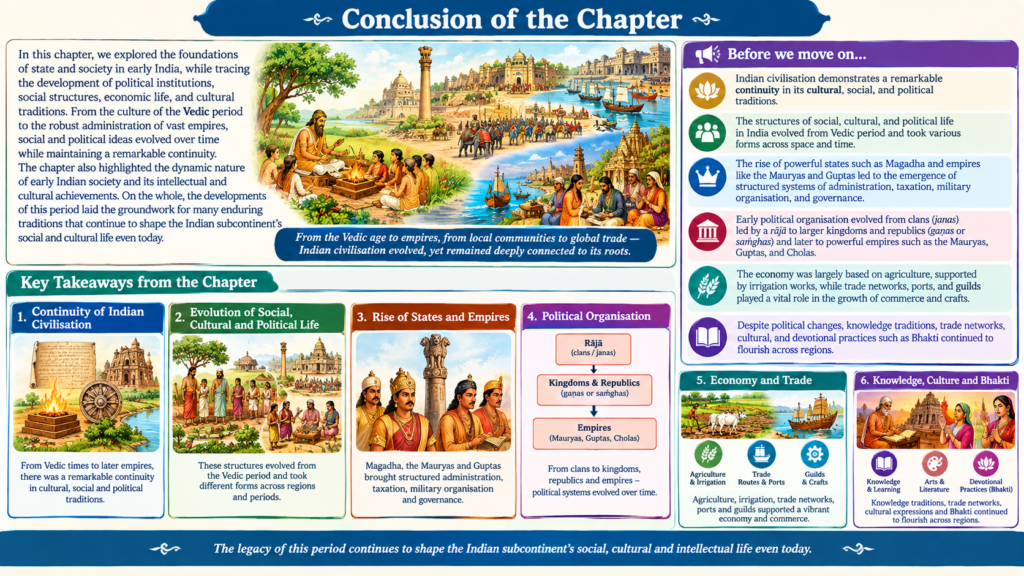
Summary of the Chapter